The Sonic Soul of Typography: Unveiling Aleandra on the Soundwaves
Typography is the voice of the written word. While we often speak of a font’s “personality” or “tone,” these are usually metaphorical descriptions of visual weight and historical context. However, what happens when typography is derived not just from visual tradition, but from the physics of audio? This question lies at the heart of a unique design journey, born from late-night sessions and the mesmerizing visual rhythm of soundwaves. It is the story of Aleandra on the Soundwaves, a typeface that attempts to bridge the sensory gap between what we hear and what we see.
The Genesis of an Idea: Visualizing the Invisible
The creation of Aleandra on the Soundwaves began not with a pen and paper, but with an audio interface and a fascination for oscillation. The designer, an illustrator by trade, found themselves captivated by the visual representation of audio frequencies on a monitor. The way sound waves rise and fall, the erratic yet rhythmic peaks, and the fluidity of the waveform presented a visual language that traditional calligraphy often lacked: organic movement.
This fascination sparked a challenge: could the energy of a soundwave be translated into a handwriting font? The goal was to create a typeface that didn't just look like handwriting but felt like it possessed a rhythmic "soul." The result is a script that flows with the unpredictability of a live performance, offering a distinct alternative to the rigid, mechanical spacing of standard digital fonts.
Anatomy of the Soundwave: Key Characteristics
Understanding the utility of Aleandra on the Soundwaves requires a closer look at its anatomical structure. Unlike standard sans-serifs, this font relies on intricate details to convey its energy. The design philosophy centers on three main pillars: the swash extensions, the stylistic alternates, and the underline accents.
Artistic Swash Extensions
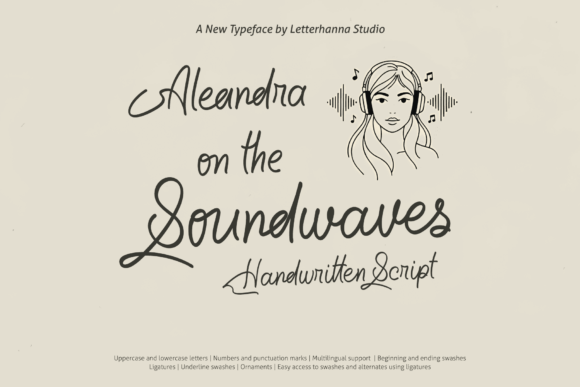
The most immediate visual identifier of this font is its generous use of swashes. These are not merely decorative additions; they are designed to mimic the long, trailing decay of a reverb tail in music production. When used in headings, these extensions allow letters to interact with one another, creating a sense of connectedness and flow that guides the reader's eye across the page.
Flexibility Through Stylistic Alternates
One of the challenges with decorative fonts is repetition. If a script letter looks exactly the same every time it is typed, the text can feel static. To combat this, Aleandra on the Soundwaves includes a comprehensive set of stylistic alternates. This allows designers to swap out specific characters to change the rhythm of the text. For instance, a capital "S" might have three different variations, ranging from a subtle loop to a dramatic, wave-like curve. This flexibility ensures that the typography remains dynamic, preventing the "digital soullessness" that can occur with overused font files.
Striking Underline Swash Accents
Perhaps the most practical feature for designers is the inclusion of underline swashes. In many script fonts, underlining text requires a separate layer or manual drawing. In Aleandra on the Soundwaves, specific keystrokes trigger a sweeping underline that connects letters, grounding the text and adding a layer of emphasis. This feature is particularly useful for creating logos or call-to-action phrases where visual weight is required.
Practical Applications: Where Audio Meets Visual
The true test of a typeface is its application in the real world. Because Aleandra on the Soundwaves was designed with energy in mind, it excels in environments where capturing attention and conveying emotion are paramount. It is not a font for body text in legal documents, but rather a tool for creative expression and branding.
Music and Band Branding
For musicians and bands, the visual identity must reflect the auditory experience. This font is particularly effective for genres that rely on emotion and movement, such as indie, soul, acoustic, or electronic music. Album covers, merchandise, and tour posters often suffer from generic typography. By utilizing the swash-heavy nature of this font, artists can create a visual identity that feels as curated as their sound. The handwritten nature suggests authenticity, while the soundwave-inspired curves suggest modernity.
Event Posters and Promotion
In the crowded visual landscape of event promotion, a poster has roughly three seconds to make an impression. The dynamic nature of Aleandra on the Soundwaves breaks the visual grid. It can be used to highlight the headline act or the name of the event, creating a focal point that stands out against geometric backgrounds. The font’s ability to look "expensive" and artistic helps elevate the perceived value of the event, whether it is a music festival, an art exhibition, or a creative workshop.
Content Creation and Social Media
With the rise of video content and social media graphics, creators are constantly looking for ways to make text overlays more engaging. Static text can often get lost in a busy video feed. However, the fluid lines of this font mimic the movement of video. It is excellent for quote cards, YouTube thumbnails, or Instagram stories where the text needs to convey a specific mood—be it romantic, energetic, or whimsical—quickly and effectively.
Packaging Design
Packaging is about storytelling on a small scale. For products that want to convey a sense of craftsmanship or artisanal quality—such as craft beverages, boutique perfumes, or handmade goods—the handwritten style of Aleandra on the Soundwaves is highly effective. It suggests that a human being was involved in the process, adding a layer of trust and intimacy between the product and the consumer.
The Psychology of Flow: Why This Font Works
Why does a font based on soundwaves appeal to the human eye? The answer lies in the psychology of visual flow. Humans are naturally drawn to curves and organic shapes over rigid angles. This phenomenon, known as the "contour bias," suggests that we find curved objects more beautiful and less threatening than sharp-edged ones.
Aleandra on the Soundwaves leverages this bias. By incorporating the fluidity of audio waves, the text feels alive. It suggests motion even in a static image. For the viewer, this creates a subliminal sense of energy and excitement. When a business uses this font for a logo, they are not just spelling out their name; they are visually vibrating with a frequency that attracts attention.
Implementation and Considerations
While the aesthetic appeal is strong, implementing a highly stylistic font like Aleandra on the Soundwaves requires technical awareness. To maintain readability and professional standards, designers should consider the following workflow tips.
Hierarchy and Pairing
Because the font is dense with swashes and details, it should rarely be used for long paragraphs. It is a display font, meant for headlines, sub-headers, and logos. To create a balanced design, pair it with a clean, geometric sans-serif font. The contrast between the organic, hand-drawn nature of Aleandra and the mechanical precision of a font like Helvetica or Roboto creates a sophisticated visual hierarchy.
Spacing and Kerning
The swash extensions in Aleandra on the Soundwaves can sometimes encroach upon neighboring letters. Designers must pay close attention to kerning (the space between specific pairs of letters). In some cases, tracking (the overall spacing of the word) may need to be increased to accommodate the wide flourishes without causing the text to look cluttered. Proper spacing ensures that the "soundwave" effect looks intentional rather than chaotic.
Color and Contrast
Given the font's intricate details, it performs best on solid, high-contrast backgrounds. Avoid placing this text over busy photographs or complex textures, as the delicate swashes can get lost. A solid background allows the "soul" of the lettering to shine through, ensuring that the dynamic curves are fully visible to the audience.
Conclusion: The Harmony of Art and Function
In a digital age where content is ubiquitous, finding a way to communicate with soul is a significant challenge. Aleandra on the Soundwaves